
Why Workforce Transition, Not Technology, Paces Industrial AI Adoption
- Michael Guilfoyle
- 1 day ago
- 8 min read

Updated: 15 hours ago

Transitioning Career Paths for the Autonomous Era
This article series will explore how industrial organizations and those investing in the modernization of these heavy-asset industries need to consider the current integration of AI technologies.
Specifically, it tackles the main challenge holding back widespread use of scalable AI, enterprises attempting to force autonomous, agentic AI decision making into static org charts and decades-old job roles. This series:
• Maps out the challenges and reveals where investment fails and capital is being lost
• Defines a pathway forward from current operations to ubiquitous human/machine autonomous collaboration.
Key Findings:
• The Operational Bottleneck: Industrial AI breaks primarily due to data quality issues and deep-seated organizational barriers, rarely model capability. While data issues are being addressed via data fabrics, organizational barriers persist because human authority over autonomous systems is not measured as a core competency.
• De-risking Adoption Pushback: To protect software adoption curves, the transition model must integrate the worker, offering career progression, industry-standard credentials, and time-boxed bridge roles.
• Quantifying Trust for Leadership: Data shows industrial operators feel safe trying new tools but mistrust motives. Corporate silence inhibits engagement. Leaders must treat labor as an asset to be transitioned rather than a cost to be eliminated and show how they will do so.
• The Investment Bottom Line: You cannot achieve a workforce that empowers humans to architect, orchestrate, and rule the silicon swarm without a transition methodology based on certified decision rights. This fact will greatly influence what technology wins in the market and at what pace.

Recognizing the Endpoint Delusion
A considerable amount of thought leadership in the industrial AI market is spent discussing, at loud volume, an endpoint, while consistently delivering silence on the difficult transition of getting there. This is particularly true from an organizational design perspective.
Most discussion focuses on the arcs of the pendulum, either pointing out the disconnect itself or jumping to the endpoint of ubiquitous industrial AI. Vendors (both emerging and established), integrators, and the analyst community tend to present a frictionless future built around powerful AI orchestrators and the benefits of continuous optimization, even as they acknowledge the distance between the present and future states.
Where it is noted, such as the European Commission’s Industry 5.0 work or in academic research, it still overwhelmingly leans into:
• Function
• Knowledge progression
• Human-centered outcomes, such as safety
Also, it treats the human and the digital as effectively separate, built around pillars of enforcement to protect humans at high risk, rather than connected via a competency-defined career path. It’s not wrong, per se, it just doesn’t detail the how of getting there or point to standards that do so.
This transition void leaves operations stranded in a "Can’t Get There from Here" loop when it comes to investing in AI-driven modernization. Boardrooms and leadership fund ambitious pilots based on an endpoint vision they’ve either created or been sold, assuming the muddiness of getting there is simply part of the journey.
When these initiatives fail to scale beyond isolated deployments, blame generally defaults to data issues and technical limitations. Truth be told, the first issue certainly is a thing, but it is getting solved, and the latter is quickly becoming less common.
If the finger then gets pointed at organizational culture or design, it rarely leads to actions that address change management processes never meant to support the vision of the autonomous AI endpoint. In application, industrial AI breaks on:
• Data quality and context issues
• Deep-seated organizational barriers
• Lack of workforce transition structure.
Even within academic circles, a development path is still seen as underdeveloped or conceptual in theory and practice. We’ve yet to see a verifiable manufacturer pathway that details how to move a production operator into a named, credentialed AI-supervision role with:
• Stated competency requirements
• Authority-based performance metrics.
The analysis of this gap is not to criticize the groups championing the technology and change. If you have one, we’d love to hear from you.
The lingering of this transition gap has had the effect of creating viewpoints that lead to tension around them.
• For the executive, it explains why expensive pilots stall despite the seeming effectiveness of the technology performance.
• For the workforce tasked with carrying out the move to agentic AI, it produces trust issues and anxiety.
People are uncertain about jobs and careers in industrial environments is because nobody seems to have codified the answer. Work is being done to narrow the gap or at least provide targets, as seen through examples such as:
• Corporate-wide programs like Unilever’s DigiOps.
In one of our future articles, we’ll follow up with some additional analysis of Unilever’s approach, as it begs the question of what skills are necessary for the transition.
I’m sure there are other examples that are just being walled off and held back from the market, based on the framework being considered critical competitive intellectual property (IP). Forward-thinking firms are undoubtedly solving these transition dynamics operationally behind closed doors without revealing their playbooks.
Regardless, these activities are the exception, not the rule, and are occurring in isolation. An organization, much less an industry, can’t promise to or actively transition its workforce to an endpoint without:
• Frameworks to do so
• Measurements and accountability systems
• A timeline that determines success or failure
We’ll outline the four key components of that framework here and follow up with more detail in subsequent articles.
Replacing Traditional Progression
Measuring Trust
Inverting Pilots
Building Decision Structure

Redefining Progress from Seniority Ladder Accession to Decision Authority
The legacy industrial career ladder framework was built on assumptions that are being systematically dismantled by agentic AI. Notably, it is taking aim at the performance metrics that use time-based measurement as an indicator of competency, including:
• Increased experience
• Recall ability
• Improved recognition
Traditionally, industrial organizations have valued this experience because, in environments where stability and risk mitigation are end goals, learning from and eliminating operational upsets and their signals was analogous to expertise.
It was an accepted rule that the tribal knowledge of a decades-long career was almost always better than that of any entry-level worker. That rule became fact, based on the amount of exposure to learning that came from time in a role.
However, the AI lifecycle undercuts this tenure-based career path as this expertise becomes contextualized within an industrial knowledge graph. When thirty years of knowledge can be instantly queried or acted upon, the value of experience-based expertise is marginalized and has a finite shelf life limited by the pace agentic systems grow in use.
The workers don’t become instantly worthless. Some companies have made this miscalculation and suffered considerably. However, over time their value shifts considerably from experience-based recognition and passive knowledge recall to active decision judgement.
Industrial organizations need to replace the seniority-based vertical progression ladder. In its place, career progression is designed around decision authority. Worker value is defined by measuring the combination of:
• What you are trusted with (consequence)
• The amount of supervision (oversight) required to carry out that authority
This taxonomy is then applied to the standard lexicon of AI decision making, under which they operate:
• Human-in-the-loop (HITL)
• Human-on-the-loop (HOTL)
• Human-in-command (HIC)
• Agentic autonomy (AUTO or HOOTL)
• Human-only where AI is walled off (WALL)
The vertical movement of legacy career paths isn’t necessary, as a sideways move to lower levels of supervision is genuine advancement. For instance, an operator who transitions from a supervised HOTL role to an unsupervised HIC role authoring critical processes has made significant progression.
Most importantly, this model offers a clear competency and accountability pathway to earn more valued decision rights. It’s the modern career path for a world where AI and the industrial workforce collide.
However, the transition to this model is in opposition to the legacy compensation architecture that dominates workforce structures today. They simply don’t fit into the definitions of job role bands now, which often map to legacy KPIs, such as:
• Headcount managed
• Budget size
• Signing authority
In an AI world, a role could have ultimate oversight authority over high-consequence decisions of forty autonomous agents with zero direct human reports. Incentivization and compensation bands need to be determined and communicated before the new role is activated.
Until the money is actually attached to jobs that have consequence-oversight rights it is all just organizational design in theory.

Trust as a Measurable Input
If you were to create a word cloud for AI, trust would likely be the dominate term. It will probably remain that way until industrial leaders and vendors selling AI solutions stop treating it as a subjective, cultural issue.
In the world of industrial AI, trust must be a quantifiable operational metric that limits or accelerates technology adoption. Currently, the industrial sector is operating under a severe trust deficit. According to PwC’s Global Workforce Hopes and Fears survey of more than 50,000 respondents:
• Only 56% of manufacturing workers feel safe trying new digital technology
• Just 42% trust in leadership’s motives
The reason is straightforward, as “capacity reallocation” and “upskilling” are seen as coded language for layoffs and early retirement.
No surprise, and clearly an inhibitor of technology adoption.
Corporate leadership must shed its cone of silence when it comes to the job-threat implications of AI deployment. Conversely, those that continue to loudly overcompensate in the other direction doth protest too much.
Transparency, commitment, and support, even in face of uncertainty, boosts trust when it comes to AI. A survey from Gallup seems to bear that out. Though the results are correlative, data showed a 15-point engagement gap between organizations that provide a clear AI plan and those that do not.
When frequent use of AI, a plan, and active support are also present, engagement in a younger cohort grew significantly.
Treating the workforce as an asset that is worthy of transitioning (and demonstrating clearly how this is done) needs to be a mandate for the C-suite.
Realizing that workforce transition is a definable path to a clear endpoint where humans have pathways to compensation-based value, leadership also needs to be held accountable for the success or failure of this movement.

Inverting Effort to Avoid Pilot Failure
The failure to scale hinges on the misalignment between technological autonomy and certified human authority. Though it is deceptively difficult to recognize, nowhere is this more present than the failure to understand and resource starting points effectively.
With boards and leadership, the shiny object nature of AI is all too prevalent. However, the step change potential of AI exacerbates this challenge in a way and at a pace that past technological disruptions have not. When leadership, innovation groups, and steering committees fund AI pilots, they tend to prioritize high-value and high-visibility project, even if they then try to limit the scope of its footprint.

In doing so, they then misalign authority with effort.
When AI micromanagement occurs in low-consequence projects, it overwhelms operators with low-value and high-volume alerts. The result is a reality misaligned with business case expectations and projected ROI.
Conversely, letting agents act at a consequence level that exceeds the human oversight can lead to catastrophic failure or loss of life.
To avoid these tendencies, industrial organizations must invert them based on physical consequence:
• For low-consequence operations, authority lag should be applied, understanding that oversight limitations will be realized in the form of manageable costs.
• For high-consequence parameters, authority should lead the technology. agentic AI must never execute change without humans who are decision certified and authorized to intervene.
For either scenario, scale is achieved by ensuring technological deployment moves at the speed of certified human authority.

Begin by Building Authority-Based Decision Structures
Before allocating another dollar of spend or investment, construct an authority-based workforce decision structure. It costs nothing beyond time and sweat equity, but poorly deployed AI will cost millions.
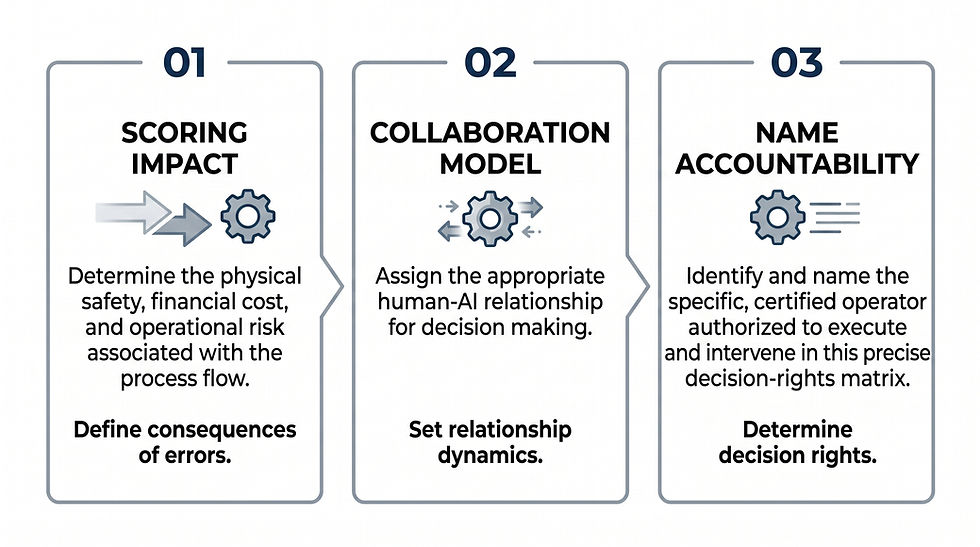
In doing so, however, don’t mistake it for a workforce transition program. For every process flow (or group) or proposed process, determine three variables. First, note the physical consequence level. Then assign the oversight mode. Finally, name of the specific individual certified to effectively carry out that combination of decision rights.
While this decision structure will have initial holes and will evolve, it answers for the organization and the workforce as to:
• Who has the right to make the decision
• How it is done
• When it can happen
• What value for success and consequence for failure
Until you do so, you have no workforce transition structure, incentivization lever, and ability to reach the endpoint. In other words, you can’t get there from here.